
The Layered Stress Model
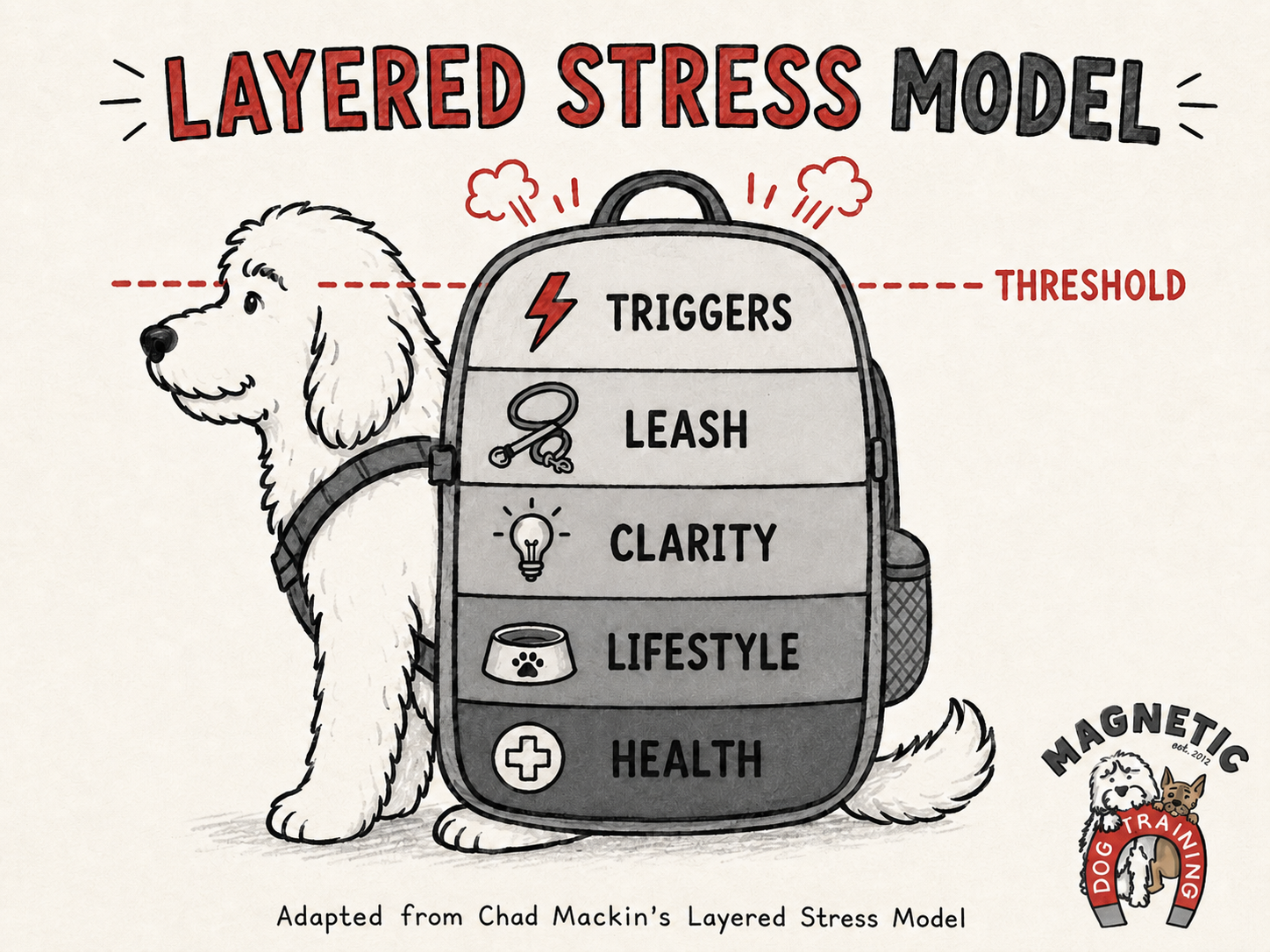
Want it on your fridge? Click HERE to download and print the Layered Stress Model.
Every dog carries stress in layers, like weight in a backpack. When the pack gets too full, they go over their threshold and react. The trick is to work from the bottom up, because the bottom layers are usually the real problem, even when the top one is all we can see.
Health — Is your dog medically healthy and comfortable? Pain or illness colors everything above it, so this gets ruled out first.
Lifestyle — Is your dog's life actually meeting their needs? An unfulfilled dog will find their own outlet, and it's often the behavior you're calling a problem.
Clarity — Does your dog understand the rules, taught clearly and kept consistent? A dog who's always guessing carries stress they don't need to.
Leash — Are you using the leash to communicate, or just to restrain? Used as pure restraint, it becomes one of the biggest sources of frustration there is.
Triggers — The thing everyone blames: the runner, the mailman, the other dog. But the trigger is usually just the last straw on a full pile. Lighten the layers underneath and most triggers shrink on their own.
Start at the bottom. Check each layer. Fix what needs fixing. Keep moving up. Then deal with whatever's left.
Want the full breakdown? Here's each layer in depth.
The Layered Stress Model
I learned about the Layered Stress Model from Chad Mackin and Jay Jack. I've seen Jay Jack in person numerous times, and the Layered Stress Model is always a key part of his presentation. It's that important.
In a nutshell, it gives us the areas we need to look at, in order, when our dogs have a problem. It starts with health at the bottom and works its way up through lifestyle, clarity, and leash, to triggers at the very top. The important part is that we check them in that order: Is the dog medically healthy and comfortable? Is their lifestyle actually meeting their needs? Do they understand what's expected of them? Are we using the leash in a way that helps rather than adds frustration? Only after we've looked at those things do we get to the trigger itself.
Sometimes we'll find something in one of the lower layers that needs addressing. Sometimes everything checks out and we keep moving up. The point is that we don't skip straight to the behavior we can see.
Think of it simply. If there's an underlying health problem that hasn't been taken care of, trying to fix anything above it is going to be inefficient at best. If a dog has hurt its leg and snaps when someone tries to touch it, trying to train that away isn't going to solve the real problem. No matter how much training we put in, the leg still hurts. We need to deal with the leg first.
Here's a more in-depth look at each layer.
Health
Health always comes first, and it doesn't have to be something major like a broken bone.
Think about how you behave when you really need to go to the bathroom. Or when you have a terrible headache. Or when you're way too hot. When something in our body is bothering us, it takes up attention, and we usually have less patience and less capacity for everything else. Dogs are no different. Pain, stomach issues, allergies, illness, lack of sleep, overheating, or simply not feeling well can all affect behavior.
So anytime something seems off with your dog, especially if their behavior changes suddenly, your first job is to ask whether there could be something medical going on. That may mean a trip to the vet. If the dog is healthy and comfortable, we check that box and move up. If they aren't, we deal with that first.
Lifestyle
Every dog has a lifestyle that works best for them, and it's your job to figure out what that is.
This is bigger than simply asking whether your dog gets enough exercise. What does your dog actually need to feel fulfilled? How much physical activity, and what kind? Do they enjoy playing with other dogs, or do they prefer people? Do they like tug, fetch, sniffing, running, exploring, training? How much rest do they need? What does your particular dog need?
A lot of behavior problems get worse when a dog's lifestyle isn't meeting their needs. Think of a dog bred to run and work all day, now living in an apartment with one short walk. That need doesn't just disappear. The dog will often find their own way to meet it, and sometimes that turns into the exact behavior the owner is calling a problem.
Your job is to look honestly at the dog in front of you and ask whether their lifestyle makes sense for who they are. And that's not separate from training. It's part of training.
Clarity
Clarity is about knowing what you do and don't want from your dog, teaching it, and keeping those expectations reasonably consistent.
A lot of the time, dogs behave in ways that don't work in our day-to-day lives simply because they don't know any better. Nobody has clearly taught them what the rules actually are. It's confusing to be allowed on the couch on Monday and scolded for it on Tuesday. It's confusing to be celebrated for jumping on one person at the door and pushed away by someone else. It's confusing when pulling on the leash usually works, but every once in a while we suddenly get frustrated about it.
Clarity means asking: Does my dog actually understand what I want here? Have I taught it? Are the people in the house generally on the same page? Does the dog know how to be right?
When the answer is no, adding clarity can take a lot of unnecessary frustration out of the relationship.
Leash
The leash is one of the layers people least expect.
Most of us think of a leash as something that keeps the dog from running away, or gets them from one place to another. But the leash is also one of the main ways we communicate with our dogs outside, and depending on how we use it, it can either help or add a tremendous amount of frustration.
Think about a dog who sees something they want to get to. The dog pulls. The leash gets tight. The owner pulls back. The dog pulls harder. Now both sides are frustrated. Repeat that enough times, around dogs, people, squirrels, smells, skateboards, or anything else the dog cares about, and the leash itself starts becoming part of the problem.
Here's the shift I want you to make: the leash is a communication tool. It can guide, it can give information, it can create boundaries, and at the right times, it can allow freedom. Ideally it becomes a conversation between you and your dog instead of a constant tug of war.
So before deciding your dog has a problem with whatever they're reacting to, ask another question first: are we using the leash well? If we aren't, that's worth fixing before we blame the trigger.
Triggers
Triggers are the specific things, mostly outside of your control, that seem to set your dog off. The runner. The mailman. The skateboard. The other dog across the street. The stranger walking through the door.
Triggers get most of our attention because they're easy to see. The dog appears, then your dog barks. Someone reaches toward the food bowl, then your dog growls. So naturally, we assume the thing that happened right before the behavior caused the whole problem.
Sometimes it did. But sometimes it was simply the last thing added on top of everything underneath it. That's why triggers come last. Before we decide the other dog across the street is the problem, we check the layers underneath. Is our dog healthy? Is their lifestyle being met? Do they have clarity? Are we using the leash well?
If the answer to all four is yes and the dog is still struggling with that particular trigger, now we have something much more specific to work on. And sometimes a trigger does need to be addressed directly. That's okay. The Layered Stress Model isn't telling us to ignore the problem in front of us. It's telling us not to assume it's the whole problem.
Start at the bottom. Check each layer. Fix what needs fixing. Keep moving up. Then deal with whatever is left.
